Vietnam - Japan local cooperation is oriented toward a strong shift into research, technology development, innovation, and the implementation of projects with concrete results.
On the morning of September 6 in Hue City, the Hue City People's Committee coordinated with the Ministry of Foreign Affairs and the Embassy of Japan in Vietnam to organize the Vietnam - Japan Local Cooperation Forum 2026.
The forum's theme was "Vietnam - Japan Local Cooperation: Creating a digital, green, and sustainable future - From strategic commitments to practical actions." The event was attended by Prime Minister Le Minh Hung.
Also in attendance were Minister of Foreign Affairs Le Hoai Trung; Minister, Chairman of the Government Office Dang Xuan Phong; Minister of Science and Technology Vu Hai Quan; leaders of ministries, branches, central and local agencies; Ambassador Extraordinary and Plenipotentiary of Japan to Vietnam Ito Naoki; and representatives of Japanese economic organizations and enterprises.
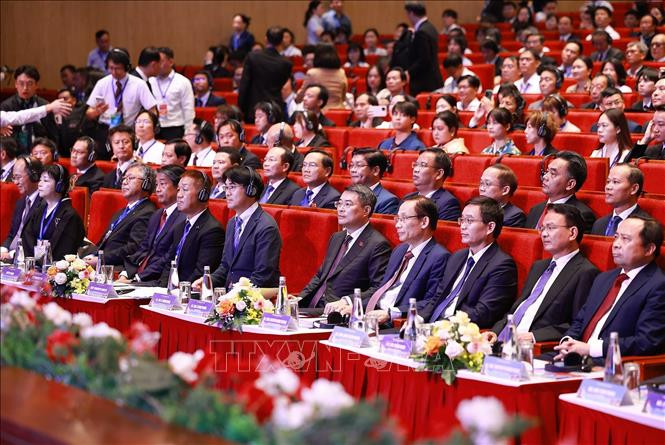
Delegates attending the Forum.
Cooperation must be measured by results
Delivering a directing speech at the Forum, Prime Minister Le Minh Hung suggested five orientations for delegates to focus their discussions on, thereby promoting increasingly practical and effective Vietnam - Japan local cooperation.
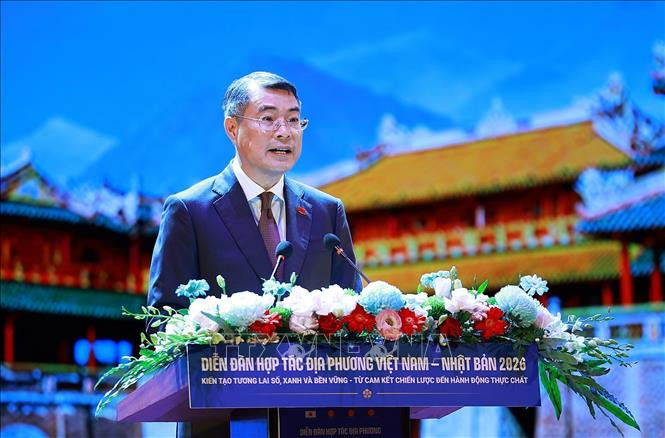
Prime Minister Le Minh Hung: The two countries need to research and promote cooperation models in digital technology, artificial intelligence (AI), semiconductors, smart cities, sustainable agriculture, startup incubators, and research and development centers. (Photo: Hue Department of Science and Technology).
First of all, Vietnam and Japan need to identify each other as high-quality growth and strategically autonomous partners based on science, technology, innovation, and digital transformation.
The two sides need to research and promote cooperation models in digital technology, artificial intelligence (AI), semiconductors, smart cities, sustainable agriculture, startup incubators, and research and development centers.
According to Prime Minister Le Minh Hung, Japan can share its experience, support Vietnamese localities and enterprises in building an innovation ecosystem; promote digital transformation within local governments; and improve policy-making and governance capacity in new strategic fields such as AI, semiconductors, quantum technology, and satellites.
Prime Minister Le Minh Hung emphasized that cooperation must be implemented in the spirit of "choosing right, deploying fast, following through to the end, and measuring by results," while simultaneously taking localities, businesses, and citizens as the center.
Along with that, Vietnam and Japan need to consider cultural exchange and mutual understanding as the foundation for long-term cooperative relations; strengthen cooperation in green transformation, climate change response, and natural disaster prevention and control capacity building.
Japanese localities can share experiences through specific projects on green infrastructure, urban flood prevention, waste and wastewater treatment, smart agriculture adapted to climate change, renewable energy, and natural disaster prevention and control.
Regarding the direction of science and technology cooperation development between the two countries, Minister of Science and Technology Vu Hai Quan assessed Japan as one of Vietnam's leading important economic, investment, and ODA partners, actively contributing to technology development, infrastructure, human resources, and economic modernization.
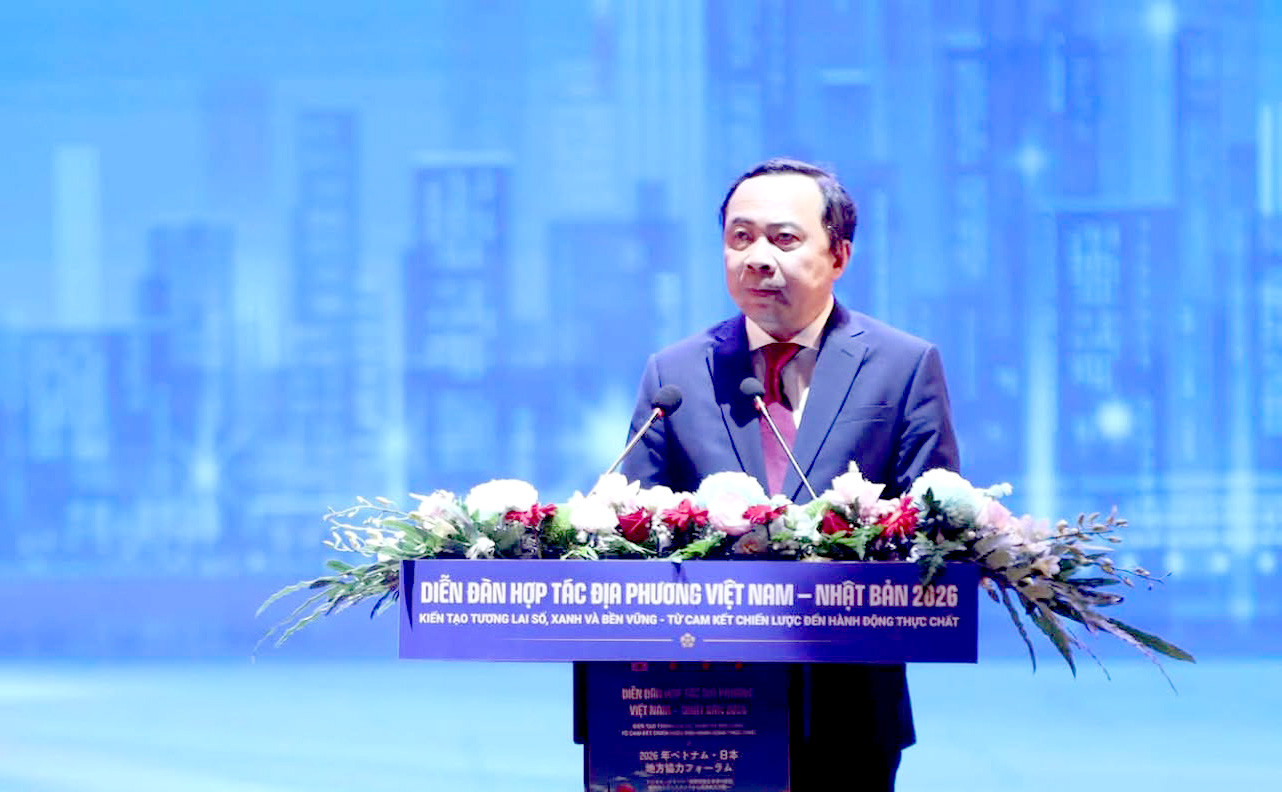
Minister Vu Hai Quan: The two countries need to shift from processing and assembly cooperation to cooperation based on science, technology, innovation, and research and development. (Photo: Hue Department of Science and Technology).
In the context of AI, big data, the semiconductor industry, green technology, and digital transformation changing production models, governance, and the global value chain, Minister Vu Hai Quan believes that Vietnam - Japan cooperation needs to be elevated to a new height, based on promoting the complementary strengths of both countries.
Japan has strengths in science and technology, the manufacturing industry, semiconductors, automation, AI, green technology, and experience in developing smart infrastructure. Meanwhile, Vietnam has a dynamic economy, a large market, a young labor force, and a developing innovation ecosystem.
According to Minister Vu Hai Quan, the two countries need to transition from processing and assembly cooperation to cooperation based on science, technology, innovation, and research and development. Thereby, Vietnamese enterprises can participate more deeply in product design, research, testing, production, and commercialization.
Cooperative relations also need to shift from the "transferor - receiver" model to jointly identifying problems, jointly researching, jointly investing, and jointly sharing the market.
Towards specific programs and projects
Minister of Science and Technology Vu Hai Quan suggested the forum focus on discussing the construction of local innovation centers and technology incubators, connecting governments, research institutes, universities, businesses, investment funds, and experts.
The two sides need to promote joint research, technology transfer and commercialization, and build a controlled sandbox mechanism; apply big data, AI, green technology, and satellite data in transportation, energy, the environment, natural disaster prevention, disease control, and public service delivery.
In addition, the two countries can select a number of localities and priority problems to deploy smart city, emission reduction, and carbon neutrality models. The implementation needs to clearly define focal points, resources, progress timelines, and evaluation indicators as a basis for replication.
Also at the Forum, Secretary of the Hue City Party Committee Nguyen Dinh Trung expressed confidence that, with an open, sincere, and reliable spirit geared towards mutual benefit, the Forum would not only bring valuable lessons but also initiate many practical initiatives.
Secretary of the Hue City Party Committee Nguyen Dinh Trung: Hue City desires to continue expanding and deepening cooperative relations with Japan, prioritizing areas such as science and technology, innovation, digital transformation, and smart and sustainable urban development.
By connecting demand with capacity, and linking ideas with resources, initiatives are expected to gradually transform into specific programs and projects, creating further momentum for cooperation between Vietnamese and Japanese localities.
According to Secretary Nguyen Dinh Trung, Japan is always an important and reliable partner of Hue City. The presence and operation of Japanese businesses in the area are a testament to the economic cooperation potential between Hue and Japanese partners.
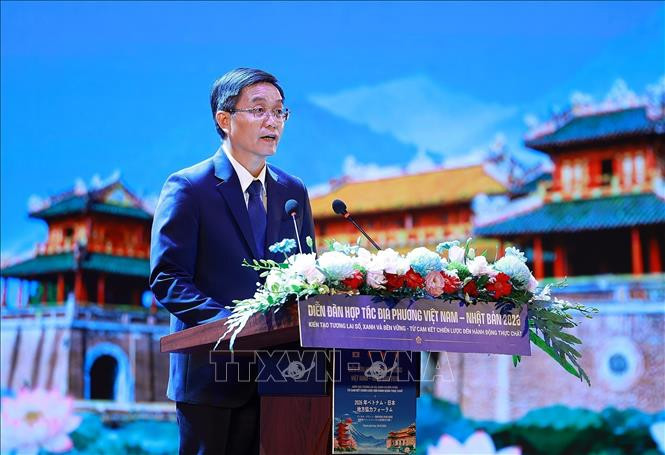
Hue City desires to continue expanding and deepening its cooperative relations with Japan, prioritizing areas such as science and technology, innovation, digital transformation, and smart and sustainable urban development; conserving and promoting heritage values tied to tourism; education and training; and investment, trade, and the development of economic zones and industrial parks.
The forum is expected to open up new cooperation opportunities in the fields of science and technology, innovation, high-quality human resource training, digital transformation, green transformation, the semiconductor industry, and AI.
Source: https://vjst.vn/viet-nam-nhat-ban-mo-rong-hop-tac-ve-phat-trien-cong-nghe-dmst-102974.html