Although the development of social housing for low-income earners and industrial workers has received special attention and incentive policies from the Government to encourage investment in recent years, results remain limited. According to experts, in the coming period, alongside creating favorable mechanisms and policies, adequate resources are essential to support social housing development.
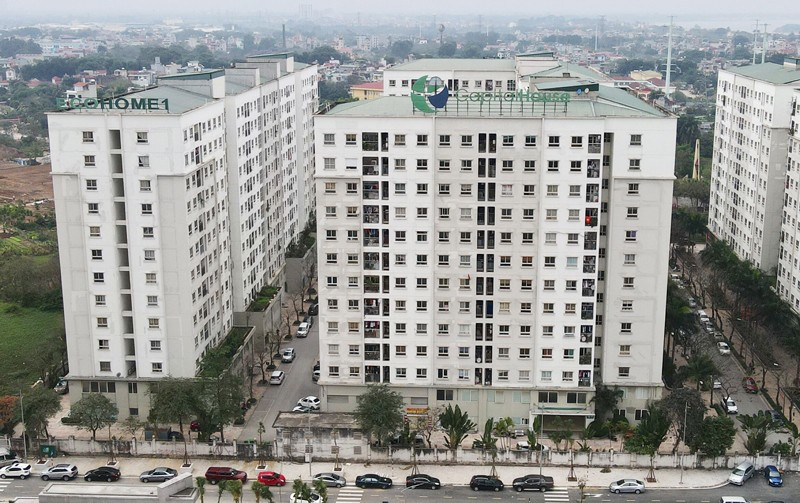
To date, Hanoi City has completed 23 social housing projects and is deploying 43 ongoing projects. In the photo: Ecohome 1 social housing area in Bac Tu Liem District. Photo: Nguyen Quang
Shortage of resources and land funds
Under the National Housing Development Strategy to 2020, with a vision to 2030, the Government set a goal to construct 12.5 million square meters of social housing floor space by 2020. However, by the end of 2020, the country had only completed 249 social housing projects, comprising approximately 104,200 apartments (equivalent to 5.21 million square meters of floor space). In Hanoi, according to the Hanoi Housing Development Program for the period up to 2020 with an orientation toward 2030, the city targeted developing 6.2 million square meters of new social housing floor area. By December 31, 2020, Hanoi had completed 23 projects (over 1.23 million square meters of floor space, equivalent to 12,796 units) and was implementing 43 projects (over 3.6 million square meters of floor space, equivalent to 49,721 units).
According to Bui Xuan Dung, Director General of the Housing and Real Estate Market Management Agency (Ministry of Construction), two main groups of causes account for the failure to meet social housing development targets:
- Shortage of clean land reserves for project implementation, as several localities failed to designate land funds clearly for social housing when planning urban areas and industrial zones.
- Lack of financial resources for social housing development. "During the 2016–2020 period, state budget allocations for social housing development channeled to the Vietnam Bank for Social Policies were low, reaching about 2,163 billion VND out of the 9,000 billion VND proposed by the State Bank of Vietnam, meeting only about 24% of actual demand. Meanwhile, funding for interest rate subsidies for the four commercial banks designated to offer loans under social housing policies according to the capital plan through 2020 (a capital demand of 248.63 billion VND) remained unallocated," stated Mr. Bui Xuan Dung.
In addition, certain mechanisms and policies for social housing development remain misaligned with market mechanisms, failing to incentivize and attract economic sectors to invest. Le Huu Nghia, Director of Le Thanh Construction and Trading Co., Ltd., shared that when participating in a social housing project, an enterprise takes about five years to recoup capital, thereby losing out on commercial housing business opportunities. Although granted land-use levy incentives, profit margins for social housing projects are capped at 10–15% due to price controls—well below commercial housing returns—leaving businesses reluctant to invest.
State support is essential
On October 28, 2021, the Ministry of Construction proposed a credit support package for social housing development alongside specific mechanisms and policies. Accordingly, the Ministry recommended that the Prime Minister approve the inclusion of a 65,000 billion VND credit package in the Socio-Economic Recovery and Development Program following the COVID-19 pandemic.
This proposal includes:
- 15,000 billion VND from the 2021–2025 medium-term public investment plan allocated to the Vietnam Bank for Social Policies for individual borrowers to buy, lease-purchase, build, or repair housing, and to provide interest rate subsidies for designated state-owned commercial banks to assist social housing developers and eligible individual beneficiaries borrowing under policy regulations.
- 50,000 billion VND in refinancing for commercial banks to extend preferential loans to industrial workers, developers of rental accommodation for industrial zone workers, and social housing project developers.
Addressing the Ministry of Construction's proposal, Le Hoang Chau, Chairman of the Ho Chi Minh City Real Estate Association, stated that if the 65,000 billion VND credit package is approved by the Government, the housing issue for workers will be resolved.
Deputy Minister of Construction Nguyen Van Sinh noted that the Ministry also proposed a mechanism binding provincial People's Committees to the responsibility of planning and allocating land funds for social housing, particularly worker housing in industrial parks. This involves rolling out solutions to facilitate land access, streamline administrative procedures, and support and attract developers to social housing projects. Furthermore, developers would be allowed to deduct site clearance expenses when paying land-use levies; developers investing in worker housing could also account technical and social infrastructure investment expenditures into the overall infrastructure costs of the industrial park. "If the Ministry of Construction's proposals are approved by the Government, the allocated public investment capital will generate strong momentum and deliver positive impacts to the economy," Deputy Minister Nguyen Van Sinh affirmed.
Source: Developing social housing: Mechanisms and resources required