With citizens' housing demand continuously rising, Hanoi City is accelerating the progress of social housing construction projects and striving for completion before 2025.
Striving for 22 projects to be completed before 2025
Hanoi currently has around 50 ongoing social housing investment projects with a total floor area exceeding 3.2 million m². Given the surging housing demand, nearly half of these projects will be accelerated to finish before 2025.
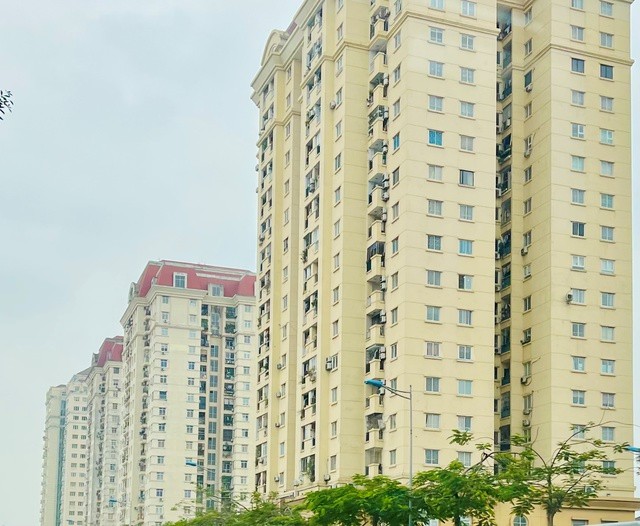
In the current period, social housing is vital and requires accelerated development. Photo: Thuy Chi
To expand the social housing land fund for low-income earners, Hanoi continues to review land reserves and propose plans for new social housing construction.
Accelerating implementation, a project on To Huu Street in Trung Van Ward, Nam Tu Liem District, is under construction and expected to be one of the 22 projects expedited for completion before 2025.
Additionally, Hanoi is considering constructing standalone social housing developments along the ongoing Ring Road 4 to create new development corridors and facilitate transportation.
The remaining 28 social housing projects—accounting for over 2 million m² of residential floor space—are projected for completion after 2025. To meet this target, Hanoi is finalizing investment policy approvals to organize investor bidding for 2 social housing complexes, alongside drafting detailed master plans for 3 additional sites.
Another piece of welcome news for low-income earners seeking better housing is the Hanoi People's Committee's recent approval of the housing development plan to 2025. The plan targets developing 1.215 million m² of social housing floor area in the 2021–2025 period. Notably, over 220 billion VND will be allocated to finish and repurpose abandoned structures from the Phap Van - Tu Hiep student dormitory project into social housing after more than a decade of disuse.
Commenced in 2009 on a prime plot south of the capital—adjacent to the Phap Van - Cau Gie expressway, Ring Road 3, Giai Phong Street, and close to multiple colleges and universities—the dormitory project saw only two buildings operational after over 10 years. The remaining blocks were largely left as bare concrete shells, causing massive waste.
In 2017, the Hanoi Department of Construction proposed converting blocks A2 and A3 from dormitories to social housing for sale and lease via public-private partnerships, but the plan was not executed. In early 2023, Hanoi officially approved a municipal budget-funded conversion plan.
According to a representative of the Hanoi Civil Works Construction Investment Project Management Board, the conversion from student housing to social housing is technically favorable. However, the process entails extensive administrative procedures, making the expected completion date for the conversion 2025.
Real estate experts emphasize that because demand for social housing is critical, the Hanoi People's Committee must promptly finalize investment policy approvals to proceed with investor bidding for two social housing complexes.
Concurrently, authorities must draft detailed master plans for three concentrated social housing zones and evaluate proposals for developments along Ring Road 4 and other strategic locations.
The city also needs to continue auditing the 20% and 25% land allocations inside commercial housing and urban area projects to supplement social housing reserves for low-income residents.
13 social housing projects slated for groundbreaking and sales launches in 2023
To satisfy housing demand, Hanoi published a list of 13 social housing projects scheduled to break ground and commence sales in 2023:
- NHS Trung Van: Located at plot HH-02A southeast of To Huu Street (Trung Van Ward, Nam Tu Liem District), launched earliest. Spanning 2,726 m², it will provide 275 apartments (225 social housing units and 50 commercial units) starting from 19.5 million VND/m². Jointly invested by NHS Construction Investment JSC and Construction Investment JSC No. 4 with total capital exceeding 570 billion VND, accommodating approximately 560 residents; basement foundation work is currently underway. Applications were received from March 28 to May 11, with the initial offering comprising 157 units for sale and 68 for lease. Massive demand led to crowds waiting overnight to purchase application dossiers.
- Green Tower Dai Mo (Nam Tu Liem District): Located in urban functional zone DM1 Dai Mo (Dai Mo Ward), covering 3.3 hectares, developed by FLC Group. Offers 500 units starting from 18 million VND/m²; construction has not yet started.
- Rice City To Huu (Nam Tu Liem District): Situated on To Huu Street across Me Tri and Trung Van Wards, covering 6,616 m². Comprises 320 units with prices starting from 18 million VND/m², developed by BIC Vietnam JSC. Currently built up to the second floor.
- Rice City Thuong Thanh (Long Bien District): Located on Gia Quat Street, Thuong Thanh Ward, developed by BIC Vietnam JSC. Built on 5,129 m², currently undergoing site leveling; will supply roughly 510 apartments starting from 24.7 to 30.5 million VND/m².
- Him Lam Thuong Thanh (Long Bien District): Located at Alley 90, Gia Quat Street, Thuong Thanh Ward, developed by Him Lam Thu Do JSC. Covers over 6 hectares, bringing 1,450 units to market at 17 to 18.6 million VND/m²; currently undergoing site leveling.
- Bao Ngoc City (Long Bien District): Located in Thach Ban Ward, developed by Bao Ngoc TTC Investment JSC. Spans 0.86 hectares, supplying 808 units starting from 17 million VND/m²; site clearance is underway for construction preparation.
- Rice City Thach Ban (Long Bien District): Located at plots CT8 and CT9 in the Thach Ban Ward commercial housing area, spanning 1.95 hectares, developed by BIC Vietnam JSC. Projected to supply 814 apartments from 20 million VND/m²; construction has not commenced.
- Social Housing 393 Linh Nam (Hoang Mai District): Located on Linh Nam Street, Vinh Hung Ward, spanning 6,616 m², offering 980 units from 17 to 18 million VND/m², developed by Hoa Binh Co., Ltd. Currently, only the mock-up units are complete.
- Social Housing 4-6-8 Vinh Hung (Hoang Mai District): Located at Alley 321 Vinh Hung Street, Vinh Hung Ward, covering 8,700 m², offering 980 units from 17 to 18 million VND/m², developed by Hoa Binh Co., Ltd. Currently, only mock-up units are complete.
- Dai Kim Center Point (Hoang Mai District): Located at plots CT4 and CT5 in Dai Kim New Urban Area, Nguyen Xien Street, developed by Hanoi Construction Investment Company No. 2 (Hacinco). Covers 2 hectares with 980 units priced from 18 million VND/m²; basement foundation is under construction.
- Hong Ha Eco City (Thanh Tri District): Situated in Tu Hiep Commune, covering 16.7 hectares with 3,283 units priced from 26.5 to 35.6 million VND/m². The Sakura tower has been handed over; Rose and Maple 1 & 2 towers are currently under construction.
- UDIC Eco Tower Ha Dinh (Thanh Tri District): Located at plot N01 in Ha Dinh New Urban Area, Tan Trieu Commune, spanning 9,305 m² with 216 units priced from 15 million VND/m². Developed by a consortium of Urban Infrastructure Development Investment Corporation (UDIC), Hanoi Water Electricity Installation and Construction JSC (Haweico), and DAC Hanoi Housing Development and Trading JSC. Basement foundation work is ongoing.
Hanoi's market continues to experience a shortage of new project launches and affordable housing. According to Savills Vietnam, only 12,600 new apartments were launched across Hanoi last year—an 8-year low—with over 80% falling into Grade B, pushing the average primary price to nearly 47 million VND/m².
To bolster supply, the Government directed the State Bank of Vietnam to deploy a 120 trillion VND credit package—accounting for approximately 12% of total capital requirements—to support social housing development for 2021–2030. Preferential interest rates are set 1.5% to 2% lower than the medium- and long-term average lending rates of state-owned commercial banks. Concurrently, the State Bank of Vietnam coordinates with the Ministry of Construction and relevant agencies to define project catalogs, target groups, and eligibility criteria.
Key considerations for buyers of social housing
Social housing refers to residential properties subsidized by the State for specific beneficiaries under statutory support policies.
Unlike commercial housing, social housing is restricted to eligible groups. Article 49 of the 2014 Housing Law defines beneficiaries eligible for social housing support:
- People with meritorious services to the revolution;
- Poor and near-poor households in rural areas;
- Rural households in areas frequently affected by natural disasters and climate change;
- Low-income earners, poor households, and near-poor households in urban areas;
- Employees working in enterprises inside and outside industrial zones;
- Commissioned officers, non-commissioned officers, professional servicemen, and defense workers in police and military units;
- Cadres, civil servants, and public employees;
- Individuals who have returned official residences per Clause 5, Article 81 of the Housing Law;
- Students of academies, universities, colleges, and vocational schools, as well as students of public ethnic boarding schools during their studies;
- Households and individuals whose land is expropriated and subject to demolition under the law, who have not received compensation in the form of housing or residential land.
Currently, apartment buildings are the most common social housing format. Under Decree 100/2015/ND-CP, social housing apartments must have a minimum usable area of 25 m² and a maximum of 70 m², conforming to approved construction planning. Provincial People's Committees may adjust the maximum apartment area upward by no more than 10% (exceeding 70 m² up to 77 m²) based on local conditions.
Buyers looking into secondary social housing transactions should exercise caution. Resale prices at several occupied social housing projects across Hanoi have risen sharply, with listings running 2 to 3 times higher than their initial launch rates.
For instance, a project in Bac Tu Liem originally launched around 16.5 million VND/m² now sees secondary asking prices around 30 to 34 million VND/m², with some social media listings inflated even further. Recent trends show that developments with solid construction quality and accessible locations consistently appreciate.
Multiple social housing projects trade at levels comparable to pre-owned commercial apartments: Rice City Song Hong (Long Bien) opened 5 years ago at over 13 million VND/m² and now records secondary trades at 26–27 million VND/m²; Dai Kim (Hoang Mai) and Ngo Thi Nham (Ha Dong) are resold at 3 to 4 times their original launch prices. Newer offerings have been approved at opening prices near 20 million VND/m², rather than the previous 13–14 million VND/m² baseline.
Nguyen Van Dinh, Chairman of the Vietnam Association of Realtors, noted that as housing demand expands against scarce supply, social housing owners who no longer reside in their units naturally seek to resell them at regular commercial market prices.
However, experts caution that by law, social housing purchasers must occupy the unit for at least 5 years before they are legally permitted to transfer ownership. Many units listed on the secondary market fail to meet this condition, having been occupied for only 2 to 3 years. Reselling under these conditions violates statutory regulations and exposes buyers to significant legal and financial risks. Prospective purchasers must thoroughly verify whether an apartment is classified as social housing or regular commercial housing to prevent avoidable disputes.
Accelerating social housing development remains essential to secure stable accommodation, upgrade living standards for low- and lower-middle-income urban populations, maintain social stability, and ensure equity across urban areas.
Efficient allocation of social housing investment also stimulates local socio-economic expansion, benefits urban industries, drives the renewal of degraded quarters, and creates opportunities for broader infrastructure development. Crucially, expediting construction supports commodity markets, stimulates low-income consumer spending, and underpins sustainable socio-economic progress.
Source: http://moc.gov.vn/vn/tin-tuc/1184/76221/day-nhanh-tien-do-du-an-nha-o-xa-hoi-phuc-vu-nguoi-dan-thu-nhap-thap.aspx